Master Spanish verb tenses with this complete guide! In just 20 minutes, you’ll gain a clear understanding of every verb tense, whether you’re a beginner or need a refresher. Don’t miss the free PDF download with all tenses and key irregular verbs to enhance your learning!
On this page
IntroductionIn Spanish we have 3 types of verbs:Let’s start with the present. PRESENTE DE INDICATIVOPretérito perfecto compuesto (Present perfect)Pretérito perfecto simple (Simple past)Pretérito Anterior (Former past)Pretérito imperfecto (Past progressive)Pretérito Pluscuamperfecto (Past perfect)Futuro simple (Future)Futuro compuesto (Perfect future)Condicional simple (Conditional)Condicional compuesto (Perfect conditional)EL MODO SUBJUNTIVOPresente de subjuntivo (Present subjunctive)Pretérito imperfecto del subjuntivo (Imperfect Subjunctive Tense)Pretérito pluscuamperfecto del subjuntivo (Past perfect subjunctive tense)Futuro simple de subjuntivo (Future subjunctive tense)TIEMPOS NO VERBALES:MODO INDICATIVOMODO SUBJUNTIVOMODO IMPERATIVO:ConclusionIntroduction
Welcome to the complete Spanish verb tenses guide! I will explain every single verb tense in 20 minutes. After reading this article or watching the video below, you will have a way better understanding of Spanish grammar. Whether you’re a beginner or an advanced learner looking for a refresher, today’s lesson is made for you.
To help you with this, I’ve created a free PDF with all the Spanish verb tenses. You can download it by clicking the download button below. I’ve also included some irregular verbs there to complete the explanation.
Click Here to download the PDF
So let’s go! I’ll explain all the tenses first, and after that I’ll put examples of each tense for you to process the tenses better. And to finish, a quick recap that will make things very easy for you, so read or watch till the end.
In Spanish we have 3 types of verbs:
Verbs that end in -AR
Verbs that end in -ER
And verbs that end in -IR.
We also have 3 different moods:
Modo indicativo (Indicative mood)
Modo subjuntivo (Subjunctive mood)
Y Modo imperativo (Imperative mood)
El indicativo has 10 tenses, el subjuntivo has 6 tenses and el imperativo has just 1 tense.
Let’s learn them all! Starting with the non-finite verb forms, las formas no verbales.
Infinitivo (Infinitive): the verb ending in -AR, -ER or -IR. Today we’ll use CANTAR (To sing), COMER (To eat) and VIVIR (To live).
Gerundio (Gerund):
Cantando (Singing)
Comiendo (Eating)
Viviendo (Living)
Participio (Participle):
Cantado (Sung)
Comido (Eaten)
Vivido (Lived)
Infinitivo compuesto (Perfect infinitive): Haber + participle.
Haber cantado (To have sung)
Haber comido (To have eaten)
Haber vivido (To have lived)
Gerundio compuesto (Perfect gerund): Haber in gerund + participle.
Habiendo cantado (Having sung)
Habiendo comido (Having eaten)
Habiendo vivido (Having lived)
MODO INDICATIVO (Indicative mood)
We use the indicative mood to talk about anything factual, true events. It is the mood we use the most. We have 5 simple tenses and 5 perfect tenses.
Let’s start with the present. PRESENTE DE INDICATIVO
| PRONOUNS | CANTAR | COMER | VIVIR |
| Yo | Canto (I sing) | Como (I eat) | Vivo (I live) |
| Tú | Cantas (You sing) | Comes (You eat) | Vives (You live) |
| Él/Ella | Canta (He sings) | Come (He eats) | Vive (He lives) |
| Nosotros/as | Cantamos (We sing) | Comemos (We eat) | Vivimos (We live) |
| Vosotros/as | Cantáis (You sing) | Coméis (You eat) | Vivís (You live) |
| Ellos/as | Cantan (They sing) | Comen (They eat) | Viven (They live) |
If the verb is regular, the verbs of the same group (-ar, -er, -ir) will have the same endings. You have the endings of each tense in green so you can note them.
We use the present tense for facts, descriptions and things that you usually do. Like in English.
Carolina canta muy bien (Caroline sings very well)
Yo como macarrones todos los jueves (I eat macaroni every Thursday)
Nosotras vivimos en Sevilla (We live in Sevilla)
Each simple tense is related to a perfect tense. El presente is connected with…
Pretérito perfecto compuesto (Present perfect)
This tense is made with the verb HABER, which is irregular, in the present tense plus the participle of the verb you are conjugating. So you only need to learn this verb HABER. It means “there is, there are”, and it works like HAVE in English.
He
Has
Ha
Hemos
Habéis
Han
- Cantado / Comido / Vivido (have sung, have eaten, have lived)
We generally use the present perfect for actions related to the present or that have taken place immediately before the present moment.
He cantado una canción por la mañana (“I have sung a song this morning”)
Ana ha comido hoy en mi restaurante favorito (“Ana has eaten in my favorite restaurant today”)
Mis abuelos han vivido muy felices (My grandparents have lived very happily)
Now, how do you talk about actions that happened yesterday or even ten minutes ago? That’s where the past tenses come into play. Up next, we tackle the preterite and imperfect, and you’ll learn when to choose the right past tense every time.
Pretérito perfecto simple (Simple past)
| CANTAR | COMER | VIVIR |
| Canté (I sang) | Comí (I ate) | Viví (I lived) |
| Cantaste (You sang) | Comiste (You ate) | Viviste (You lived) |
| Cantó (He sang) | Comió (He ate) | Vivió (He lived) |
| Cantamos (We sang) | Comimos (We ate) | Vivimos (We lived) |
| Cantasteis (You sang) | Comisteis (You ate) | Vivisteis (You lived) |
| Cantaron (They sang) | Comieron (They ate) | Vivieron (They lived) |
We use it to talk about completed actions in the past, actions that took place in a specific time in the past.
María le cantó una canción preciosa a su novio (Maria sung a beautiful song to her boyfriend)
Ayer comí lentejas (Yesterday I ate lentil stew)
Mi abuelo vivió la guerra civil (My grandpa lived through the civil war)
The perfect tense related to the simple past is:
Pretérito Anterior (Former past)
This is formed with the verb HABER conjugated in pretérito perfecto simple + the participle of the verb you are conjugating.
Good news for you, we don’t really use pretérito anterior nowadays, just in literature. But here it is:
Hube
Hubiste
Hubo
Hubimos
Hubisteis
Hubieron
+ Cantado / Comido / Vivido
The pretérito anterior expresses that a past action took place before another action in the past. But for that, we use another tense. Stay tuned!
Tan pronto como hubo cantado, se fue al hotel (As soon as he had sung, he went to the hotel)
Pretérito imperfecto (Past progressive)
We use the pretérito imperfecto to talk about an action that was ongoing or that was habitual in the past.
| CANTAR | COMER | VIVIR |
| Cantaba (I sang) | Comía (I ate) | Vivía (I lived) |
| Cantabas (You sang) | Comías (You ate) | Vivías (You lived) |
| Cantaba (He sang) | Comía (He ate) | Vivía (He lived) |
| Cantábamos (We sang) | Comíamos (We ate) | Vivíamos (We lived) |
| Cantábais (You sang) | Comíais (You ate) | Vivíais (You lived) |
| Cantaban (They sang) | Comían (They ate) | Vivían (They lived) |
Mi madre cantaba en el coro cuando iba a la escuela primaria (My mum used to sing in the choir when she was in primary school)
Nosotras comíamos mucho pescado cuando éramos pequeñas (We used to eat a lot of fish when we were little)
Tú vivías en Barcelona en aquella época (You lived in Barcelona at that time)
The perfect form derived from the pretérito imperfecto is the…
Pretérito Pluscuamperfecto (Past perfect)
We use it to talk about an action that took place before another action in the past. We conjugate the verb HABER in pretérito imperfecto and add the participle. Like “had sung,” “had eaten…”
Había
Habías
Había-
Habíamos
Habíais
Habían
+ Cantado / Comido / Vivido
Nunca había cantado delante de tanta gente (I had never sung in front of so many people)
Ayer María se encontraba mal. Había comido demasiado antes de irse a dormir. (Yesterday María was feeling sick. She had eaten too much before going to sleep.)
Ellos ya habían vivido en Sevilla antes de mudarse aquí otra vez (They had already lived in Seville before moving here again)
Let’s draw the map of the past tenses:
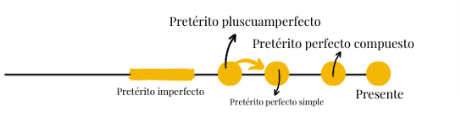
So generally, if the present is now, presente, canto, things that happened in the immediate past and ended use pretérito perfecto compuesto, he cantado. Things that happened a little or long before that and had an end, use pretérito perfecto simple, canté. Things that happened before another thing in the past we are talking about, use pretérito pluscuamperfecto, había cantado. And things that we did for some time in the past or that didn’t have a clear end, use pretérito imperfecto, cantaba.
And what about the future plans? I bet you have some future plans, so let’s go with the
Futuro simple (Future)
| CANTAR | COMER | VIVIR |
| Cantaré (I will sing) | Comeré (I will eat) | Viviré (I will live) |
| Cantarás (You will sing) | Comerás (You will eat) | Vivirás (You will live) |
| Cantará (He will sing) | Comerá (He will eat) | Vivirá (He will live) |
| Cantaremos (We will sing) | Comeremos (We will eat) | Viviremos (We will live) |
| Cantaréis (You will sing) | Comeréis (You will eat) | Viviréis (You will live) |
| Cantarán (They will sing) | Comerán (They will eat) | Vivirán (They will live) |
We use it to talk about what we will do, an action in the future, or suppositions about an action in the present or future.
Mañana cantaré a las 21:00 (Tomorrow I will sing at 9 pm)
El fin de semana comeremos paella (We’ll eat paella on the weekend)
– Nunca he vivido una pelea (I’ve never experienced a fight)
+ Ya la vivirás (You’ll experience it)
And from the future we build the perfect future:
Futuro compuesto (Perfect future)
We conjugate the verb HABER in the futuro simple.
Habré
Habrás
Habrá
Habremos
Habréis
Habrán
+ Cantado / Comido / Vivido (Will have sung, will have eaten, will have lived)
With this tense we can make suppositions about a completed action, or tell an action that will have been completed by a certain time in the future. Will have + participle.
Pasado mañana ya habrás cantado en tu primer concierto (The day after tomorrow you will have sung in your first concert)
– ¿Qué le pasa a María? (What’s wrong with María?)
+ Habrá comido demasiado (She must have eaten too much)
Cuando seamos ancianos, habremos vivido una vida muy feliz (When we are old, we will have lived a very happy life)
We also think of probabilities and hypothetical scenarios… What do we use for that? In English, the conditional is a different mood itself, but in Spanish, it is a tense inside the indicative mood.
Let’s check the…
Condicional simple (Conditional)
We use the Condicional simple to talk about hypothetical situations, give advice and make requests.
| CANTAR | COMER | VIVIR |
| Cantaría (I would sing) | Comería (I would eat) | Viviría (I would live) |
| Cantarías (You would sing) | Comerías (You would eat) | Vivirías (You would live) |
| Cantaría (He would sing) | Comería (He would eat) | Viviría (He would live) |
| Cantaríamos (We would sing) | Comeríamos (We would eat) | Viviríamos (We would live) |
| Cantaríais (You would sing) | Comeríais (You would eat) | Vivirías (You would live) |
| Cantarían (They would sing) | Comerían (They would eat) | Vivirían (They would live) |
Si yo fuera tú, cantaría todos los días (If I were you, I would sing everyday)
That “fuera” is a subjunctive tense… stay tuned.
¿Te comerías mi segundo plato? (Would you eat my second plate?) Yo viviría la vida de Taylor sin pensarlo dos veces (I would live Taylor’s life without a second thought) And what do we make out of the simple conditional? The perfect conditional!
Condicional compuesto (Perfect conditional)
We build it by conjugating HABER to the conditional and adding the participle. Like in English; I would have…
Habría
Habrías
Habría
Habríamos
Habríais
Habrían
+ Cantado / Comido / Vivido (Would have sung, would have eaten, would have lived)
We use the perfect conditional to talk about what one “would have” done or what “would have” happened in a hypothetical situation.
Si lo pudiera hacer otra vez, habría cantado otra canción (If I could do it again, I would have sung a different song) Subjunctive with conditional.
Qué pena que no vinieras, habrías comido muy bien (So sad you didn’t come, you would have eaten very well) Subjunctive with conditional.
Si Marina hubiera venido, habría vivido la mejor experiencia de su vida (If Marina had come, she would have had the best experience of her life) Subjunctive with conditional again.
If you’re a little lost in Spanish grammar, something that will help you A LOT is this Free Study Guide that you can download here. It will guide you step by step while you learn Spanish on your own.
Now, the most hated mood by Spanish learners, all Spaniards also hate it when we study it at school, but you get used to these tenses pretty quickly when you hear them being used. And I’m going to give you good news in a little while.
Let’s dive into the subjunctive mood!
EL MODO SUBJUNTIVO
We use it to give a subjective thought, and communicate things like wishes and doubts. Ojalá (I wish) is always accompanied with a subjunctive form. We also see “Si…” (If…) followed by subjunctive a lot, and subordinate clauses that start with “que” (that). Using the subjunctive well will make you advanced, so pay attention.
Presente de subjuntivo (Present subjunctive)
| CANTAR | COMER | VIVIR |
| Cante (I sing) | Coma (I eat) | Viva (I live) |
| Cantes (You sing) | Comas (You eat) | Vivas (You live) |
| Cante (He sings) | Coma (He eats) | Viva (He lives) |
| Cantemos (We sing) | Comamos (We eat) | Vivamos (We live) |
| Cantéis (You sing) | Comáis (You eat) | Viváis (You live) |
| Canten (They sing) | Coman (They eat) | Vivan (They live) |
Mainly used to express wishes and doubts:
Quiero que me cantes una canción (I want you to sing a song for me)
No creo que Ana coma pollo hoy (I don’t think Ana will eat chicken today)
Ojalá vivamos muchos años juntos (I hope we could live many years together)
With the present we can form the…
Pretérito perfecto compuesto del subjuntivo (Present Perfect Subjunctive Tense)
We conjugate the verb HABER to present subjunctive. Remember it is irregular.
Haya
Hayas
Haya
Hayamos
Hayáis
Hayan
+ Cantado / Comido / Vivido (Sang, ate, lived)
Llámame cuando hayas cantado (Call me when you have sung)
Espero que hayas comido bien (I hope you ate well)
Ojalá hayáis vivido una experiencia inolvidable (I hope you have had an unforgettable experience)
Pretérito imperfecto del subjuntivo (Imperfect Subjunctive Tense)
I really like this tense but I have something sad to tell you… There are two different forms for this tense, and both are always interchangeable. But they are very easy to remember!
| CANTAR | COMER | VIVIR |
| Cantara/Cantase (I sang) | Comiera/Comiese (I ate) | Viviera/Viviese (I lived) |
| Cantaras/Cantases (You sang) | Comieras/Comieses(You ate) | Vivieras/Vivieses(You lived) |
| Cantara/Cantase (He sang) | Comiera/Comiese(He ate) | Viviera/Viviese(He lived) |
| Cantáramos/Cantásemos (We sang) | Comiéramos/Comiésemos(We ate) | Viviéramos/Viviésemos(We lived) |
| Cantarais/Cantaseis (You sang) | Comierais/Comieseis(You ate) | Vivierais/Vivieseis(You lived) |
| Cantaran/Cantasen (They sang) | Comieran/Comiesen(They ate) | Vivieran/Viviesen(They lived) |
Also used for thoughts and wishes… Here are some examples for you to see when we use it:
Si cantáramos a las 5, podríamos salir de fiesta esta noche (If we sang at 5, we could go out partying tonight)
Ojalá comiésemos tortilla de patatas hoy (I wish we could eat potato omelet today)
Me encantaría que los perros vivieran más años (I would love for dogs to live longer)
And the perfect tense that uses this pretérito imperfecto is…
Pretérito pluscuamperfecto del subjuntivo (Past perfect subjunctive tense)
If the imperfecto has two forms, the pluscuamperfecto also has two forms. We conjugate HABER to the pretérito imperfecto de subjuntivo and add the participle.
Hubiera/Hubiese
Hubieras/Hubieses
Hubiera/Hubiese
Hubiéramos/Hubiésemos
Hubierais/Hubieseis
Hubieran/Hubiesen
+ Cantado / Comido / Vivido (Had sung, had eaten, had lived)
We use it to reflect on actions in the past that were followed by another. Most commonly, to wish something had or hadn’t happened or to give thoughts.
Si hubieras cantado más tarde, te habría podido escuchar (If you had sung later, I would have been able to hear you)
Ojalá no hubiéramos comido espinacas (I wish we hadn’t eaten spinach)
Si hubiesen vivido más tiempo, habrían conocido a sus nietos (If they had lived longer, they would have met their grandchildren)
And now the good news…
Next is the future and future perfect of the subjunctive mood. But we don’t use them! Yayyy! I think those might be used only in court. A normal person like me never uses these tenses. Now it’s old Spanish. But in case you need it, here it is:
Futuro simple de subjuntivo (Future subjunctive tense)
| CANTAR | COMER | VIVIR |
| Cantare (I will sing) | Comiere (I will eat) | Viviere (I will live) |
| Cantares (You will sing) | Comieres (You will eat) | Vivieres (You will live) |
| Cantare (He will sing) | Comiere (He will eat) | Viviere (He will live) |
| Cantáremos (We will sing) | Comiéremos (We will eat) | Viviéremos (We will live) |
| Cantareis (You will sing) | Comiereis (You will eat) | Viviereis (You will live) |
| Cantaren (They will sing) | Comieren (They will eat) | Vivieren (They will live) |
The only sentence I’ve heard with future subjunctive is a Spanish proverb that says: Adonde fueres, haz lo que vieres (Wherever you go, do what you see)
Aaaand the…
Futuro compuesto de subjuntivo (Future perfect subjunctive tense)
HABER in futuro simple de subjuntivo + participio. Never heard this tense in any conversation.
Hubiere
Hubieres
Hubiere
Hubiéremos
Hubiereis
Hubieren
+ Cantado / Comido / Vivido (Will have sung, will have eaten, will have lived)
Let’s cut the examples because you won’t use this tense.
And now the last one, yay!
MODO IMPERATIVO, the imperative mood.
And this is just one tense! And just for the second person, you! Is this paradise?
Pronouns:
Tú (You, singular informal)
Vosotros (You, plural informal)
Usted (You, singular formal)
Ustedes (You, plural formal)
| CANTAR | COMER | VIVIR |
| Canta (Sing) | Come (Eat) | Vive (Live) |
| Cantad (Sing) | Comed (Eat) | Vivid (Live) |
| Cante (Sing) | Coma (Eat) | Viva (Live) |
| Canten (Sing) | Coman (Eat) | Vivan (Live) |
Canta una canción (Sing a song)
Comed mucho (Eat a lot)
Viva su vida y déjeme en paz (Live your life and leave me alone)
Great job on following all the tenses with me! I know it was a lot, so let’s review it in a more simple way in a quick recap for you to remember, using the sentence HABLAR ESPAÑOL (To speak Spanish)
TIEMPOS NO VERBALES:
Infinitivo: Hablar español (To speak Spanish)
Gerundio: Hablando español (Speaking Spanish)
Participio: Hablado español (Spoken Spanish)
Infinitivo compuesto: Haber hablado español (To have spoken Spanish)
Gerundio compuesto: Habiendo hablado español (Having spoken Spanish)
MODO INDICATIVO
Presente: Yo hablo español (I speak Spanish)
Pretérito perfecto compuesto: Yo he hablado español (I have spoken Spanish)
Pretérito perfecto simple: Yo hablé español (I spoke Spanish)
Pretérito anterior: Yo hube hablado español (I had spoken Spanish)
Pretérito imperfecto: Yo hablaba español (I spoke Spanish/I used to speak Spanish)
Pretérito pluscuamperfecto: Yo había hablado español (I had spoken Spanish)
Futuro simple: Yo hablaré español (I will speak Spanish)
Futuro compuesto: Yo habré hablado español (I will have spoken Spanish)
Condicional simple: Yo hablaría español (I would speak Spanish)
Condicional compuesto: Yo habría hablado español (I would have spoken Spanish)
MODO SUBJUNTIVO
Presente: que yo hable español (That I speak Spanish)
Pretérito perfecto compuesto: que yo haya hablado español (That I had spoken Spanish)
Pretérito imperfecto: que yo hablara/hablase español (That I spoke Spanish)
Pretérito pluscuamperfecto: que yo hubiera/hubiese hablado español (That I had spoken Spanish)
Futuro simple: que yo hablare español (That I will speak Spanish)
Futuro compuesto: que yo hubiere hablado español (That I will have spoken Spanish)
MODO IMPERATIVO:
¡Habla español! (Speak Spanish!)
Conclusion
Review them every now and then and you’ll remember them all! It would be great if you read or listen to Spanish and analyze all the verb tenses they use there. I have this video blog speaking slow Spanish that will help you a lot. Watch it and have a look at the tenses I’m using. Keep on practicing!